Published: 03/24/2026
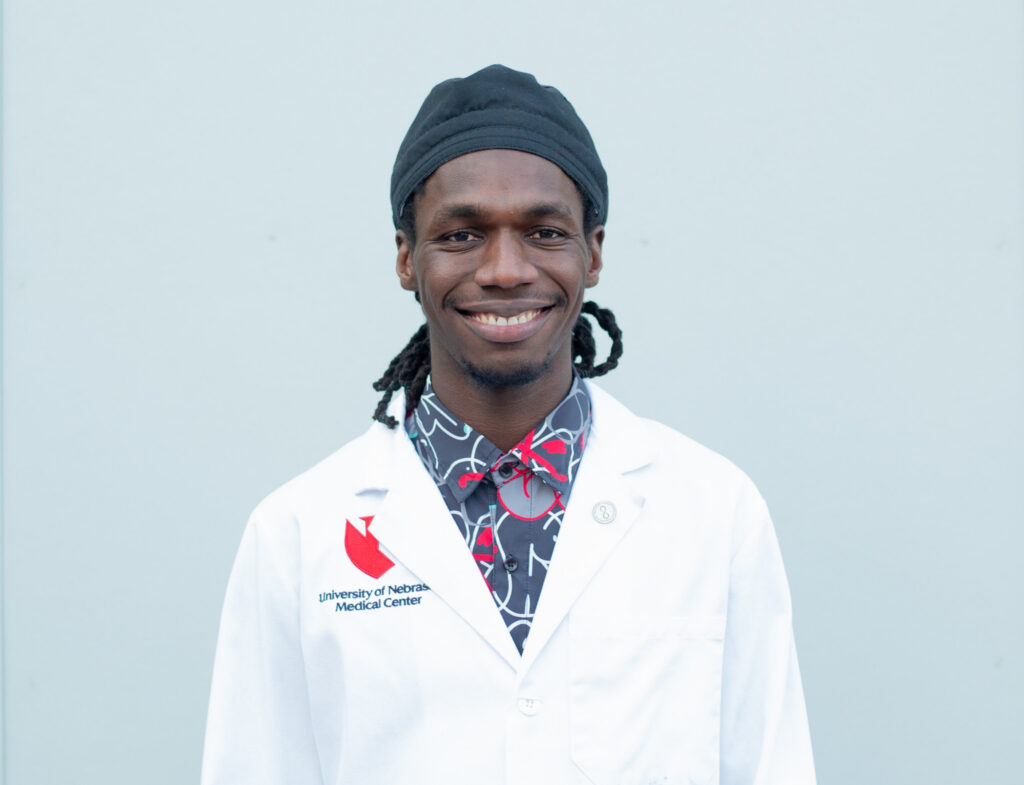
The Stanford Center for Innovation in Global Health is proud to announce the 2026-27 Global Health Media Fellow: Omar Ceesay, a medical student at the University of Nebraska Medical College, currently completing his third year.
Ceesay’s relationship with global health, he says, “did not begin through academic curiosity, but rather through lived experience in both Sub-Saharan Africa and Rural America.” Growing up in The Gambia, Ceesay narrowly survived a malaria infection and watched many friends die from the illness. When he was 11, his father died of a brain injury after being hit by a drunk driver. His death could have been prevented with proper care, but there were no practicing neurosurgeons in the country at the time. These experiences ignited Ceesay’s passion for global health and his desire to become a neurosurgeon.
When he began to pursue his medical education at the University of Nebraska, he became aware of the “profound lack of Black representation within medical education and clinical spaces. Such absence profoundly shapes how health information is taught, communicated, and ultimately received by Black communities.” This awareness sparked his passion for finding innovative ways to reach underserved populations with clear and trustworthy medical information.
Collectively, Ceesay said, these experiences revealed to him the “profound human stories that are rarely given the oxygen of publicity that they deserve.”
Ceesay empathizes with growing patient mistrust in doctors, likening it to the skepticism many feel at a car mechanic when faced with technical language they don’t understand. “The mechanic’s constant use of jargon while communicating with non-mechanics appears as an attempt to disempower and cheat the customer, even if that isn’t the case,” Ceesay notes.
“For physicians of my generation, effective communication isn’t just a professional duty, but a moral responsibility to rebuild trust by speaking in language the public can understand,” he said. “Because the gap created between what we know and can communicate is where misinformation typically breeds.”
To close this gap, Ceesay has experimented with a variety of innovative methods for reaching underserved populations. On social media, he created a widely-viewed account where he adopts the persona of “medical twins”—one representing a physician, the other embodying the concerns and questions of individuals from communities often underserved by medicine. This engaging format allows him to address medical misconceptions, answer community questions in plain language, and foster a sense of trust with audiences that traditional health communication often misses—amassing millions of views and interactions. Beyond the digital realm, Omar has brought his mission into local barbershops, transforming familiar community spaces into informal health hubs where he provides accessible, jargon-free information and creates open dialogue about health.
Ceesay plans to use this fellowship as a launchpad for health journalism and communication: “My hope is that this fellowship will transform me from a physician who can only help one patient at a time through clinical practice, to a physician-journalist who can help millions of patients at once via storytelling,” he said.
Ceesay begins his fellowship in September 2026. Learn more about the Global Health Media Fellowship here.